"MY HOUSE IS BLOWING AWAY ... AND IT ISN'T EVEN WINDY!"
 E GO BACK. Picture New York, New York in its great grey Cold War period -- the city of Automats and Polo Grounds and Flatiron Buildings. The year is 1953, the address 255 E. 50th Street at 2nd Avenue, on the east side of midtown Manhattan. Our protagonist, an indigent wit, lyricist and movie buff named Dion McGregor, has just set himself up as the uninvited houseguest of yet another friend, this one a multitalented, semi-famous entertainer named Carleton Carpenter, who has just been granted his release from an MGM acting contract. McGregor and Carpenter have recently begun writing songs together, McGregor handling the words and Carpenter the music. McGregor, known to his friends as an "inveterate freeloader," an "international freebie," and "the man who came to dinner," has made a temporary home for himself on a slide-out ottoman in Carpenter's living room.
 Despite the extravagant street noises intruding into their apartment, and despite the fact that the living room was a long hallway away from Carpenter's bedroom, midnight mutterings were heard. But McGregor's utterances were not yet the clear, spoken-aloud dreams of the sort that comprise this album -- the true epiphany was yet to come. McGregor himself would later tell a radio audience (appropriately, in the middle of the night) that he'd been talking in his sleep since he was five years old, but we can presume that back then, too, his talent was not a very well-defined one.
 In the late summer or early autumn of 1955, Carpenter's actual roommate returned to New York and McGregor was forced to find another couch to call home. He hiked the few blocks to 961 1st AVENUE (photo courtesy Ellery Eskelin), a nondescript five-storey walkup near the corner of 53rd Street, where another new songwriting partner of his named MICHAEL BARR had an apartment on the second floor. McGregor's sleeptalking was still a very occasional and unremarkable thing, and during this period Barr never even got to hear any of it. McGregor eventually moved (or was moved) up three flights to the apartment of yet another friend, Peter de Rome, a British writer and filmmaker (and later a prominent director of gay erotic films), where he lasted for a year or so as a resident of de Rome's couch.
It was during this year -- 1960, give or take a few months -- that McGregor's sleeptalking finally blossomed, and was ready to be recognized as the rare and marvelous beast that it was. Not having to hear his somniloquies himself, McGregor wasn't especially moved one way or another by them, but de Rome was intrigued. According to the introductory notes McGregor wrote to the book version of The Dream World Of Dion McGregor, de Rome "tried taking the dreams down in longhand, but the words came faster than he could write. I had a good laugh about it and then forgot it." But when de Rome told Barr about the sleeptalking, Barr immediately recognized that he had stumbled onto something special. Barr, a budding composer whose hobby was tape-recording the audio portions of movie musicals off late-night TV, was eager to turn his microphone on McGregor's dreams. McGregor, on the other hand, was not quite so eager to have his dreams turned upon, but for the historical record -- as well as for a more-or-less permanent address -- he would endure. All that he hoped to directly gain from having his dreams recorded were ideas for potential song lyrics. McGregor moved back to the spare twin bed in Barr's living room, where his exceptional talent would be voluminously documented over the course of the next seven years.
Barr's fascination with making these tapes quickly grew to an obsession. The somniloquies would typically arrive just prior to McGregor's awakening, not every morning like clockwork but rather, as if to keep Barr on his toes, four or five days per week. To compensate for their inconstancy, he would sometimes emit more than one dream in a day, amounting to as many as seven separate somniloquies in a single session.
By the time McGregor began speaking each morning, Barr would already be up and waiting for him, the microphone of his second-hand Pentron reel-to-reel recorder (soon upgraded to an Ampex) resting on a pink table behind and slightly above the sleeper's head, his own breath at half-speed in anticipation of the weirdness that was about to arise. The phone would be taken off the hook so its ring -- you never know when someone might need to call you at 6 a.m. -- would not interfere with the dream, nor with the taping of it. The tape deck itself rested in the hallway near Barr's bedroom, the better to smother his face in his pillow to stifle waves of laughter from leaking onto the tape.
By Barr's estimate, he eventually recorded over 500 of his roommate's somniloquies. McGregor complained (lightheartedly, one assumes) in the book's introduction about "the miles of tape that have taken over the apartment." In reality, the 7" reels were stored neatly in their boxes, the boxes stacked in bookshelves along the walls of the living room -- but there were a lot of boxes.
As the collection of tape reels grew, Barr began playing them for some of their friends in New York's theatrical whirl. They eventually reached the ears of producer and talent agent Jules Green, a co-creator of The Tonight Show and manager of Steve Allen, still a hot property at the time. At that point, things quickly moved into high gear. Green was struck by the alien notion of a man who dreams out loud, and by the compounded strangeness of being able to eavesdrop on those dreams. He approached Milt Gabler, A&R director of Decca Records, to suggest that Decca release an audio verité album of the best of the somniloquy tapes.
Gabler was a savvy industry insider with an ear for unique material. He had been the founder of Commodore Records, the world's first independent jazz label, which in 1939 released Billie Holiday singing "Strange Fruit," a song that directly and chillingly addressed the topic of racial lynchings in the South. "Strange Fruit" was so withering that Billie's contracted label, Columbia, had shied away from releasing it. Gabler jumped at the opportunity, and his release of "Strange Fruit" put Commodore on the map. The song's impact remains powerful enough that it merited a full-length article in the September 1998 issue of Vanity Fair, a rare achievement for a single song.
In 1954, by then a member of Decca's A&R staff, Gabler produced a New Jersey-based hillbilly combo doing their best imitation of a rhythm and blues number. The band was Bill Haley & The Comets, the song was "Rock Around The Clock," and alongside a few of Elvis Presley's early RCA releases it ignited the rocknroll era.
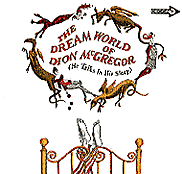 To finally make the point, Milt Gabler was a truly wild cat, who decided to release THE DREAM WORLD OF DION McGREGOR (HE TALKS IN HIS SLEEP) (left: album cover), "because I was a nut!" Gabler had no expectation nor even reasonable hope that such a strange album might do any significant business. "I knew it wouldn't be a gigantic seller," he says today, "but I thought I should do it just to show that some people talk in their sleep. This guy told complete stories and that's what I wanted to prove." Gabler adds, as if the point weren't inherently clear, "I did it because it was different." The album of ten dream-tapes was released in January of 1964.
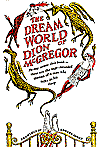 Green also played the tapes for Bernard Geis, a respected book publisher whose imprint was distributed by Random House. Unlike Gabler, Geis was looking for sales. "I thought it might catch on as a novelty," he remembers. "I thought it was quite an unusual book and took a flyer on it." On May 27, 1964, Bernard Geis Associates published THE DREAM WORLD OF DION McGREGOR (right: book cover), a collection of transcriptions of 70 of McGregor's somniloquies.
To render the gorgeous three-color (red, black and a near-golden yellow) cover illustration and the 30 black-and-white line drawings inside, Geis hired Edward Gorey, a high school classmate of his wife's who was just beginning his rise to fame as an illustrator of the whimsical and the macabre. The album jacket used virtually the same cover art as the book, but because of its different shape had to be redrawn from scratch. Gorey lettered both covers by hand, but the album bore a subtitle, (He Talks In His Sleep), that was not conferred to the book. The reason for this difference is uncertain, but it was probably just a matter of space. At a glance, however, it's hard to tell the two covers apart.
The releases were given sparse promotion. On the same day Bernard Geis Associates published The Dream World Of Dion McGregor, they also released a biography of Jean Harlow that was a tie-in to a big-budget movie starring the bombshell Carroll Baker. The Harlow book (which, by perverse irony, included several stills supplied by McGregor) got the lion's share of the company's publicity muscle, but a wee bit still managed to spill over onto their quirky little sleeptalking volume. A bookstore devoted an entire Fifth Avenue window to a display of both the album and the book. The New York Times ran a small ad. In a clever endorsement concept, McGregor was scheduled to appear at a trade show booth sponsored by the Simmons Mattress company, but that fell through. Some television appearances were planned, but they too never came to pass. The few press reviews that trickled in were mixed -- one particularly glowing one in a Tampa newspaper, of all unexpected places, seemed to get it.
 The one thing that does remain is a tape of an overnight radio program which aired on July 8, 1964, hosted by bizarro New York talkmaster LONG JOHN NEBEL. Over the course of a midnight-to-5 a.m. roundtable discussion, Nebel subjected McGregor to the taunts of his gang of smug know-it-alls, who alternately play along with and patronize our sleeptalker. But McGregor emerged imperturbed. His wall of defense was erected automatically by the fact that he was never "into" the sleeptalking nearly as much as Barr was, and so he wryly agreed with Nebel's goons that these releases were indeed fairly ridiculous. His bemused detachment allowed him to maintain dignity in the face of a barrage of misdirected spitballs. In typical fashion, Nebel even produced a hypnotist, who brought McGregor under for a while. He elicited snatches of two dreams, one a repeat of a portion of "Peony" (a dream about "a Chinese-Austrian dwarf" which appears both in the book and on the first album), the other a recreation of McGregor's failed attempt to levitate two tables and a roomful of friends. It was the levitation portion that finally impressed the panel, although it's hard to tell whether they were responding more to the dream they heard or to McGregor's telling them, after coming out of the state and hearing a playback of it, that the events he dreamt of actually happened. [transcript]
The album and the book both stiffed. Geis recalls, "I don't think we sold more than six, seven thousand copies," out of an initial press run of ten thousand. The remains were remaindered. Gabler (who really does speak in exclamation points) doesn't recall any numbers on the record, but it still stands out in his memory as "one of the biggest flops I ever put out!" He seemed more proud of the fact than distressed by it.
chapter 3:

YES! OF COURSE BANGING CEREAL BOWLS WAKES HIM!
CD home page:
DION McGREGOR DREAMS AGAIN