
July 8, 1964 / guest: Dion McGregor
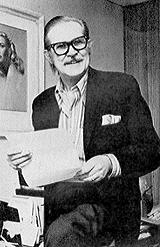
intro: goofy outer space music
Long John Nebel [LJN]: Hi, neighbors. This is Long John once again. We're around from midnight to 5:00 five mornings during the week, and of course on weekends we're around till 5:30, and that means we're on the air for some 36 hours. And during that time it's my pleasure to talk with many interesting people. ... We have a group with us tonight. Ed Springarm -- Dr. Edward Springarm is a professor of English. Mike Gurzdansky is a linguist, and a medical writer. And Kai Dee, the actor. Our guest of the morning is a gentleman by the name of Dion McGregor. Bernard Geis Associates have published a book titled The Dream World Of Dion McGregor. And, actually, Letty Cottin must have called me about four times on this. I received a copy of the book. Letty Cottin is the gal in charge of publicity over there, and one of the top people in the publishing business as far as publicity is concerned. And, I don't know, the book was mislaid or something and she sent me another copy, and we decided to do something on it. ... Now, I'd just like to read something from the jacket of the book. It says, "No one wrote this book. These are the tape-recorded dreams of a man who talks in his sleep." The book is published by Bernard Geis, and then Decca came out with an album, The Dream World Of Dion McGregor. And as I spoke to you, Dion, on the phone, I said I haven't had a chance -- so many people, I guess they never can understand this, you'll get a record or something and somebody'll say, "Well, what'd ya think of it?," y'know, about an hour-and-a-half after you've received it. I say I haven't had a chance to play it. I have albums that a needle will never get into a groove -- I just haven't had a chance. And I have not listened to this. However, you are familiar with it, you've listened to it, and you said this is OK for the air.
Dion McGregor [DMcG]: It's OK for the air.
LJN: And if I'm unemployed [laughs], I have to look up Dion McGregor and see if he can take on somebody else's obligations. It says here, "Like it says on the bottle, 'Shake well before using.' These notes should be read before playing this record." And I haven't read these, I think I will in just a few minutes while we're [laughs] ... I don't think I'm gonna read this cold. I think I'd better read this, too.
DMcG: I think side two is probably better for the air.
LJN: "The Swimming Pool"?
DMcG: That's right. [laughs]
LJN: "Mustard Battle," "Dear Uncle," "The Operation." What are you fellows laughing at -- you haven't heard the record, have you?
Mike Gurzdansky [MG]: But we've read the play ... the book.
LJN: But you haven't heard the album? No. Alright. Well, I think we might start by asking you, Are you a writer?
DMcG: Well, I'm a lyric writer. I've never written any stories or things like that, articles. Actually, I did compile a book with two other guys about Garbo, a film thing about Garbo. Her movies, with casts and credits and the plots of each film. But that's about it.
LJN: Well now, I imagine that you're not unique in dreaming. I imagine that other people dream, too. But what gave you the idea that your dreams would be worthwhile putting between two covers.
DMcG: It wasn't my idea. [laughs]
LJN: I'm not talking covers on the bed, I mean book covers.
DMcG: No. [laughs] It really wasn't my idea at all. It just evolved, after a long time. They've been recorded for about five years now.
LJN: I mean, isn't it a little unique, Dion, for a fellow who dreams to even think about putting on a recorder. Now I imagine -- I don't know -- I imagine I must dream.
DMcG: That wasn't my idea, either. I have two guys that I room with, and I was disturbing them. And one morning, one of them said, "Have your coffee and listen to this," and it was me. That's how it started. Up till then, they'd been waking me saying, "You're talking again."
LJN: Do you have any recollection of a dream, if somebody wakes you?
DMcG: An overall thing. Nothing like I hear, though. You know, the detail of it is incredible.
LJN: We've had some people on the show from time to time who are experts in dreams. I'm not talking about, you know, the people that write the dream books, or anything like that. We've had a couple of psychologists on, on the subject of dreams, and also I've read a little bit about them from, I guess in reading articles on sleep and all, because I don't get much sleep so I read about it. And it seems to me that it's been stated by the experts that a dream is something that lasts like two or three seconds.
DMcG: No, that's not true.
LJN: Well, that's what I was wondering.
DMcG: That's not true.
LJN: What'd you want to say, Mike?
MG: About a year ago, I think a couple of doctors at the University of Chicago -- somewhere in the midwest -- were doing work which essentially consisted really in recording the motion of the eyeballs and the way in which people turn over and over in their sleep. And they found that they were getting some rather odd reactions at odd times during the night, in that people's eyes would move as if they were following something and seeing something. And they'd wake them up immediately afterwards and ask them what had happened. They found that they'd been having dreams. And what it turned out was that, actually the eyes of these people underneath their closed lids were tracking, were following what they were seeing in the dreams. And much to everyone's amazement, this old -- I won't say a superstition, because it was legitimately held, the idea that hours could go by in dream-time that were only a few seconds in waking life didn't turn out to be the truth. Actually, these things would last anywhere from 20, 25 minutes. But actually, the time that you spend in the dreams, psychologically, was roughly equivalent to the time that you spent asleep and dreaming.
Ed Springarm [ES]: But, of course, this was in the middle west, where everything lasts much longer.
DMcG: I was over at one of those places, they tested me.
MG: Oh, you were? I'll be darned. This I didn't know, but it was rather disappointing, too, because I had visions of somehow their being able to duplicate the same effect with people while they're awake, with some sort of speed-up pill, so that you could spend maybe 24 hours studying for exams but objectively maybe only ...
LJN: But would you say if I were to dream about something, let's say about taking a trip in a car, that would maybe take normally an hour or an hour-and-a-half to drive, and if I dreamt about leaving my home and arriving at my destination, and if I had a complete dream, would this take me an hour-and-a-half in sleeping time to accomplish this drive of an hour-and-a-half?
MG: Here's the interesting thing about this. First of all, the correspondence is not absolutely complete. In other words, of course it's always hard to tell time without a watch anyway, but if somehow you had a way of knowing that psychologically it felt as though you'd spent a half an hour in the dream -- it might have been, say, 15 minutes, 20 minutes, it wouldn't have been a half an hour necessarily on the nose -- but also, at least I've noticed insofar as my own dreams are concerned, and I've spoken of this to other people, when you do have an extremely extended dream, generally speaking what you have are an equivalent to the dissolve or the iris shot in a motion picture. So that you literally are not spending every second of that time in your dream behind the wheel, going from Beaver's Pancreas to Upper ... uh, Islands ...
LJN: Respiratory. Yes, I've been up there, for vacation.
MG: So, there is a jumping around.
DMcG: It's time-skip.
MG: Yeah, right.
LJN: Let me ask you this, Dion. You've heard tapes of your dreams and all. What is considered a short dream? That has ... your dreams have some continuity.
DMcG: A one-line one.
LJN [incredulous]: A one-line one? Would be an entire dream?
DMcG: Well, the talking comes at an arousal period. That's what they told me. I've seen psychia- ...
LJN: You mean they're shaking you, waking you up?
DMcG: No, no. It's a period when I'm just coming awake, is what the doctor in Brooklyn told me.
LJN: And this may be 30 minutes of becoming awake?
DMcG: That's right, uh-huh. He told me that there were three dream periods an evening ... a night.
LJN: What kind of doctor are you referring to? I don't want his name. I mean, is this a medical doctor, psychologist, or what?
DMcG: Yes, it's a medical doctor.
LJN: A medical doctor?
DMcG: Uh-huh. And he's specializing in sleep, and dreams, sleep-talk.
LJN: Did he hear about you, or did you hear about him?
DMcG: No, he heard about me.
LJN: And he was interested in ...
DMcG: And he got in touch with me through Letty. And I went over there for one hectic night.
LJN: Oh, you mean you spent the night there?
DMcG: Oh, yes, I spent the night.
LJN: And how does he know you're gonna dream?
DMcG: Well, he said everybody dreams.
LJN: Every night?
DMcG: Every night, uh-huh.
LJN [incredulous]: Everybody dreams every night?
DMcG: And I can't tell you how many psychologists who told me so many people talk, too.
LJN: Well, I'm certainly not gonna debate this with you. I certainly don't dream every night. I certainly have no knowledge of it. [of course not -- he works nights]
DMcG: You know, if you were tested, you might. It's true what Mike said, about the eyelids twitch, and that's when you start to dream. About 30 minutes after you go to slee- ... after you go to bed.
LJN: Is the dreaming time?
DMcG: Uh-huh. That's the first dreaming period.
LJN: Well, supposing you sleep for eight hours. Is there a possibility that you, Dion McGregor, may dream for that entire eight-hour period, or is it usually just a half an hour a night?
DMcG: As he said, with his graphs that he showed me -- he showed me hundreds of graphs. They hit a peak at 30 minutes and then it goes off. And then the sleep is peaceful. There's another one then. There are about three or four dream periods.
LJN: Is there any relationship between your dreams, of a given night? Is it a continuation, that you pick up the dream again.
DMcG: No, no.
LJN: Something's completely foreign to the first dream.
DMcG: It never has happened.
LJN [doubtful]: Uh-huh.
DMcG: However, I've had the same dream several times, with variations.
LJN: What ... this expert on the subject, does he feel that your body is rested if you dream a considerable amount of time that you're in bed?
DMcG: He said with me, I got rid of most of my hostilities, so I was rested.
LJN: In the dreams?
DMcG: Uh-huh.
LJN: You mean and if you didn't get rid of your hostilities, you would have had the hostilities during the waking hours, and this would have sapped strength away from you?
DMcG: Probably. Yes, that's the way he explained it.
MG: They've done this. They've done this, John, that same set of experiments that I was talking about, because they could track and ...
LJN: It's my next question, thank you. My engineer wants me to get the question in right away and then he goes to sleep. We just wake him up when the food comes. He wants to know, which I was just gonna ask you too: Does a person dream in color?
DMcG: Well, I mention a lot of colors, so I assume I do. When I wake up ...
LJN: What does your doctor, what does your expert say? Did you ever discuss ...
DMcG: Well, I didn't ask that doctor. I asked another one, and he said that it's ridiculous that only women dream in color. He said he dreamt in color, too.
LJN: Is this an expert too, this man?
DMcG: This was a medical ...
LJN [reacting to an off-mic comment from the peanut gallery]: That's another show -- we're doing that one later. That's our 6:00 show this morning. [laughter all around] This other doctor that you speak of, who has this problem of dreaming like a woman, is he an expert in the field of sleep?
DMcG: No, he wasn't.
LJN: What kind of doctor is he -- medical doctor too?
DMcG: He's a medical doctor, yeah. And a psychologist.
LJN: And a psychologist.
DMcG: And a psychologist.
MG: And somewhat insecure, I should suggest.
DMcG: Well ...
MG: Confused, anyway.
DMcG: I think that's an old superstition, about women dreaming in color. Because I mentioned ...
MG: I haven't heard it, up until this point.
LJN: I never heard it, either.
DMcG: 'Cause I had heard it.
LJN: I've often wondered, though, whe- ...
MG: In high-fashion color, or just any old color that happens to come along?
DMcG: Any old color.
ES: I mean, it isn't a case of, "This fall's big color is going to be fuschia," so they dream in fuschia, or something like that.
DMcG: [laughs] No.
LJN: Well, this is pretty far ... Kai, you haven't said anything, then we're gonna go round-robin on this.
Kai Dee [KD]: That's alright, I'm just listening right now.
LJN: I thought you were dreaming.
KD: I didn't have my eyes closed.
LJN: The thing I wanna ask you about, and this may be kind of a rough question to ask you about a book: Why did Bernard Geis decide to publish this book? Now, I know, everybody's gonna say for money.
DMcG: [laughs] I wish I knew.
LJN: But in other words, this is not a thing where, y'know, people are gonna be pounding at Brentano's [a popular New York bookstore of the time] in the morning saying, "I must get a copy of Dion McGregor's Dream World," right?
DMcG: No ... No, no. I really don't know. I really don't know. He was ... I was away when the whole thing came up. I was in Dallas, writing lyrics for a musical, and they were picking all these things out to do, and there were miles of tapes to go through.
LJN: When were you in Dallas? At the time of the assassination?
DMcG: No, before.
LJN: Before that.
DMcG: Before. It was about a year ago. I only met Mr. Geis once, and it was a very brief thing. And I didn't ask him why. [laughs]
LJN: No, I don't think that you should. I was just wondering if it was something ...
DMcG: And I really don't know, don't know why. He was fascinated with the ...
LJN: With the tapes?
DMcG: ... the tapes, yeah.
LJN: And the book is made up just of ...
DMcG: Well, they're transcriptions from the tapes.
LJN: Uh-huh, uh-huh ... Well, we might go round-robin on this, and due to the fact that Dion McGregor has been in touch with members of the medical profession that feel they have some knowledge of dreams, I think it might turn out to be a very interesting discussion. I know that Mike is keenly interested, not in dreams but he is ... being a medical writer, he reads just about, or as many things as it's possible for him to read on medical subjects. And I know that Kai has a great interest in [someone coughs, obliterating the word] of the things that might be considered off-beat.
MG: I was going to say, I have Blue Cross. [laughter all around] Well, Dion, I am, to put it very mildly, bewildered by your book, because I don't even know if I ought to call it "your book."
DMcG: I know. [laughs]
MG: And inasmuch as is a book that was written, if "written" is the word, while you were asleep, perhaps the proper approach to it might be to read it while one is asleep.
DMcG: [laughs]
MG: Because I had a certain amount of difficulty with it, I must confess. And I must also confess that I didn't get all the way through, because I found it confusing, and disjointed. And while certain of the dreams, if that is the word, are amusing, or clever, certain others, it seems to my rather ritualistically-controlled mind, are simply too bewildering. I can't follow 'em, and I keep asking myself, "Why, why why?" This guy is having a ball, dreaming this stuff, y'know, I am assured by a no-doubt reputable psychiatrist in the foreword to the book that all of this is terribly legitimate, which I might otherwise doubt. But, y'know, what's in it for me? Why do I want to read this? What am I supposed to get out of it? Are his dreams better than mine? Well, perhaps they are -- I'm willing to grant it, because I never remember mine. And if I talk in my sleep, I sincerely hope I never say anything terribly revealing. And if so, there've never been any repercussions of which I know, so obviously I'm totally disqualified from any competition along these lines. But I don't know how to approach the book. However, for the sake of our readers, of, of our listeners, who haven't had an opportunity to read The Dream World Of Dion McGregor, let me take a stab at explaining what this is. The Dream World Of Dion McGregor purports to be transcriptions of tape-recordings made while Mr. McGregor was asleep, and talking in his sleep. And inasmuch as when he does talk in his sleep, he says a number of rather strange things, and there's a certain sort of weird consistency in his dreams, in that -- although many of them taper off into meaningless syllables at the end, they nevertheless produce a reasonably consistent picture of some sort or other -- certain interested parties who were privy to his talking aloud while sleeping -- and we must go into how all that started, by the way -- recorded his dreams, or recorded his speaking aloud, and this book is the result. Well now, I don't know any better way, really, to ... we're going to be playing a record of it, aren't we?
DMcG: I think so, yes. John has one.
MG: So there's hardly any point to playing any selections here. So let me just that, as far as I read, which is about halfway through the book, I found two very amusing ones. One is about the people who live in the giant's piano, which is consistent throughout, and the other one is called "Movie Screeno." But I think these were two out of 22, and the other 20 I found bewildering. I found that, unlike most books, I had the greatest difficulty reading this one. For example, it is no secret that, I think to regular listeners of this program, that I read most of the books for this show on the subway. Between the west side of Manhattan and Flatbush Avenue, on the 7th Avenue IRT, is a splendid opportunity for reading and reviewing them, for concentration, and sometime ago we even did a show in which one tested one's concentration. I tested mine on the 7th Avenue IRT, and rated 49 out of 50, or something like that, which is pretty good for subway riding, all things considered. Of course, it wasn't rush hour. And, so, I tried, you see. But then I discovered I could read one of these things between, oh, let us say, Bergen Street and Brooklyn Museum stations, but then between Brooklyn Museum and Franklin Avenue I had to stop and thing about something else, like cigarette ads up on the top of a car, or gee, the skirts are getting shorter this year, or that sort of thing, because it wasn't something I could read through consistently. And I found that taking it in very small doses -- one or two little dreams at a time -- I got along reasonably well. But when I attempted to sit down and read this as I would read any other book, there I bogged down completely. I didn't know what to make of it, I found myself losing interest, and finding very little to compensate for the number of episodes -- again, I don't know what word to use -- which I found neither amusing nor clever, but just kind of confusing.
DMcG: Mind you, I'm with you.
KD (or ES): I'm not.
DMcG: I am. I couldn't read it.
MG: Really?
DMcG: Unh-unh.
MG: Do you feel any ...
DMcG: It's all I can do to hear them.
MG: Do you feel any pride of authorship in this ... [laughs]
DMcG: No. [laughs] None.
MG: Y'know, ordinarily, a man writes a book and he's kind of proud of it. We had a man here a couple of years ago who wrote a book and it had taken him nine years, and during these nine years he said he had labored mightily and his wife had supported all the time he was writing this great work, and -- oh, it was a colossal book about lust and passion in the north woods ...
ES (or KD): French Canada?
MG: ... in French Canada, yeah. You remember that one? Oh it ... great book, no question about it.
DMcG: I think I know the book.
MG: Yeah, it was very pure and designed to point a moral, and it showed that -- well, I won't go into all the details now -- and he had enormous pride of authorship, even when we pointed out to him that this was quite possibly one of the worst books that had ever had been written on any theme whatever.
DMcG: I have no pride of authorship.
MG: OK. Fine. [laughs]
DMcG: Absolutely not. As a matter of fact, it really makes me wild that I haven't written a book. I'd love to. I compile 'em.
MG: I see. [laughs] Tell, then, let me ask you one question.
DMcG: I'm much prouder of the lyrics I've done. [laughs]
MG: Do you have regular audiences for your dreams? That is, do [sic] everybody get together and say, "Well, Dion's going to sleep now, let's all open the folding chairs and go in there and sit?
DMcG: Yes, that's happened too. Yes, the guys ... people were over there one morning, the Decca people were there one morning.
LJN: Well, they wanted to see if this was legit, is that it?
DMcG: Yeah, uh-huh. They had to come several times because the man upstairs had a party, [laughs] woke me up.
MG: With all that audience around, does the crumpling open of the popcorn bags open you up in the middle of the dream? [sic]
DMcG: Well, sometimes it's embarrassing.
MG: Do you sell admissions?
DMcG: Yes. [laughter]
LJN: Let me just say that we have this album here, and, y'know, talking about something like this is pretty difficult, due the fact that a lot of our listeners are completely unfamiliar with the book and with the album. Now, as Dion McGregor just told us, that the people from Decca and also from Bernard Geis Associates were over to hear him sleep, this ... they have a little postscript on here in the liner notes, that were written by Jules L. Green. And it says, "The imperfections of the sound are the result of the conditions under which the recordings had to be made. The background disturbances are the actual sound of the traffic and street noises on First Avenue, New York City, as Dion insists on sleeping with his windows wide open." Well, we have one little short cut. It's just a little less than two minutes. And this cut is "The Diet." Now, Dion McGregor went on a diet recently, and he has lost some 19 pounds, as he was telling us before we went on the air. And this'll give you a little idea of what actually happens during one of these recording ... uh, uh ... sessions. Walter [the engineer] and I thought that we heard a little music in the background, and it is quite possible, with the windows open, that one of his neighbors had a radio on, or something like that. [reacting to an off-mic comment] Yes, that's true. Just a faint bit of music in the air. You'd have to really build the gain up to catch it. Let's listen to this one cut.
plays "The Diet" -- ends on "Well, it's pimples and poundage." [general laughter]
LJN: Well, why even comment? You can't even review it. [laughs]
MG: In three words, "A diabetic's nightmare."
LJN: Really, it's pretty, uh ... far out. And before we go further out, I think we should interrupt at this moment to remind our listeners that this is WOR radio, your station in New York. The station that never sleeps, although sometimes you may think that these are dream sequences that the Long John Nebel Show puts on. And now, back with our guest of the morning. The Dream World Of Dion McGregor is a book published by Bernard Geis Associates, and we just played one cut from a Decca album, which will tell you, or which will give you a little idea of some of the things that happens to Dion McGregor. I'm beat ... pick it up Mike, say something. [laughs]
MG: I'm sorry, John. [laughs] I didn't realize you were gonna stall in mid-sentence. Well, first of all, because I suspect that this will enter in a good deal later, I must take radical exception with my compere on the right, Ed Springarm.
LJN: Can we use that type of word on the air, compere?
MG: Compere? It simply means, "fellow fink."
LJN: Oh, I see. Fellow fink. Alright, go ahead.
ES: It's a good thing I'm out of the room, or I think ... [general laughter]
MG: Anyway, quite seriously, I do think that with a few trifling idiosyncracies of punctuation aside, the literally quality of a good deal of this is amazingly high. I did not find any difficulty in reading it either in one swell foop or later, a few items at a time.
LJN: You're talking about the content of the book now.
MG: The book, yes, I mean that.
LJN [testily]: Alright, I'm not debating it with you. I'm just ... I want to find out.
MG: I really found interesting, I found much of it amusing, some of it hair-raising and rather gristly in a sense which was remarkably well-expressed. But I think this is the literary end of it, and you and I and Ed and Kai can get into a hassle about that later, but I'd like to deal, if I might, for a little while, with the psychological and the possibly medical end of this thing for a while. First of all, if I could ask a semi-personal question and if you have no objections, how old are you, Dion?
DMcG: Thirty-six. [he was actually 42]
MG: How long have you been doing this?
DMcG: Since about five.
MG: That's 31 years of practice. Well in this time, anybody can become a good dream-writer, let's face it. [laughs] Now, apparently, when you produce these sequences -- as you said, this was during a period of arousal, or perhaps also when you're drifting off to sleep ...
DMcG: Well, that's the way it was explained to me. To me, it's ...
MG: You have no memory of the words themselves, do you?
DMcG: No, no. Maybe loud ... uh, frightening words -- I can remember those.
MG: But do you actually ... in other words, this is described in the best ...
DMcG: Or I can wake up hearing myself with it.
MG: Now, this book describes, on the dust jacket, it says here, "the tape-recorded dreams of a man who talks in his sleep." Actually are there dreams that accompany this, or is this simply your talking without necessarily visual pictures which accompany it.
DMcG: That's what I think it is. You hit it there.
MG: In other words, these aren't really dreams. What is is, I don't wanna say "free association" ...
DMcG: I do remember things, though. When I hear it played back, I can remember ... like that operation was harrowing. I thought I was dead, I woke up dead. [laughs]
MG: One of the things that I was rather curious about is, have you ever attempted -- especially since these recordings were assembled and the book was discussed and put together -- to utilize any of the material that was taped for your own literary or artistic purposes?
DMcG: Well, I didn't, actually, but there's been a musical written, and the book was written around this character, who dreams. And it's in the process now of being shown.
MG: Well if you've got a sufficiently ... if one has a sufficiently off-beat, perhaps cuckoo-clock imagination, I can see a number of plot elements in this sort of thing that really almost cry out for expression.
DMcG: Another interesting thing, I dreamt an idea for a lyric, which I wrote the next day and, incidentally, Barbra Streisand is recording it in three weeks, which is ... [fluttery] I'm much more excited about that!
MG: You mean a funny girl happened to you on the way to the forum.
DMcG: [laughs] Yes.
MG: One thing I was wondering about is, if this started about the age of five, did your parents ever attempt to interrupt this in any sort of consistent fashion?
DMcG: Constantly. Constantly.
MG: And what was your reaction to the interruptions? I've got a reason for asking that.
DMcG: Fear.
MG: Did anger or ...
DMcG: Anger and fear. I was really afraid, a lot of the times.
MG: The reason I mention that is because in those experiments I was speaking of, and that you were too, when they attempted to ...
DMcG: Well, I was frustrated, too.
MG: Well, this is it. Because -- John, this is a rather interesting and odd thing about this -- when Dion mentioned that apparently, as far as one could tell, everybody dreams every night, the reason why most people don't think that they do is that apparently they forget it entirely that they ever have. And as part of the experiment, they took a number of volunteers, had them sleep while their reactions were being monitored, and then by reading the graph they can see at what point the dream sequences began. And without necessarily waking them up but just by pushing them slightly, so as to almost get their mind out of kilter, the dream sequence would fade and damp out. And they would do this constantly all night long, so that the individuals were getting sleep under the proper conditions -- the rooms were proper temperature and humidity -- they were not being physically awakened, the only thing was that they were not dreaming, and after a period of something like about a week, I recall, they began to develop a great deal of irritability -- anger, flash temper -- and in some cases even began to develop things that would be analogous to either severe neuroses or psychoses, which cleared up spontaneously when they were allowed to get back their dreaming ...
DMcG: Well, that accounts for temper tantrums as a child, because I had them all the time. And it might have come from that. [laughs]
MG: One of the things that interests me, not so much from the medical angle but as a writer of nonmedical material as well, is that something which I have held to be more or less as an idealistic act of faith with some evidence, but not too much, to back it up, seems to be confirmed from this material, which is my feeling that almost any individual who is not a certifiable imbecile or idiot has natural abilities as a creative artist, which for one reason or another simply never do rise to conscious awareness. If one wishes to define it arbitrarily -- and, of course, I do -- one can then say that the artist -- good, great, mediocre or have-it-what-you-will -- is simply the person who to a greater or lesser extent is able to consciously become aware of and manipulate this raw material which is constantly floating around in the brain, and which most people apparently don't verbalize even as well as you do much less ever become conscious of.
DMcG: Well, the psychologist that I talked to said that if I went through analysis, it might bring that closer to the conscious and I could write freer. Now, I don't know about that.
MG: Well, this is placing, I suspect, more faith in psychoanalysis than is warranted.
DMcG: That's right. That's what I figured.
MG: But if there were some mechanism, whatever it were, I suspect this would not only be true of you but I would say probably of 99% of the human race. But, of course, what in the name of goodness one could do with, say, 99% of the human race being reasonably good writers is horrifying to contemplate. I'm sorry, John, I didn't mean to ...
LJN: Do you think a person can learn when they're asleep, y'know this ...?
MG: Oh, this hypnopedic jazz.
LJN: Yeah, well it's a ...
ES: I love the way he throws that off like that, "hypnopedic." And what means this word you just ...
MG: You had Brave New World there, didn't you, Frank? [I think he means Ed]
ES: Yeah.
MG: Remember "hypnopedia"?
ES: No.
MG: Sleep-teaching. That's where they put this little microphone under your pillow and ...
LJN: Not a micro- ... a speaker, you mean.
MG: Well, a loudspeaker, whatever ... uh, pardon me, I'm sorry, right -- an earplug or something.
LJN: Well, I imagine that you'd rather have a speaker than a microphone there. Dion McGregor uses a microphone but most people use a speaker, y'know what I mean? [laughs]
MG: That's what made me choose that word, John.
ES: No, of all the things that might be put under my pillow, I can think of very few that attract me less than this. [laughs]
MG: Put a tooth and you get a penny. What happens when you put an entire upper plate? You hit the jackpot.
ES: Well, if you roll over in your sleep you'd get some curious effects.
KD: I wanted to ask you, Dion: since the taping, how long has your clan, I'll call them, been taping your dreams?
DMcG: Ever since. It's been about a year now since this book went into publication, or getting it together, and ever since then they've been doing it. But they've been taping them for about five years, all told.
KD: Oh, they've been taping them for about five years.
DMcG: Uh-huh, uh-huh.
KD: And you are aware of the fact that they were taping them, for five years.
DMcG: Yes. Uh-huh, uh-huh.
KD: Did you develop an extra interest in dreams?
DMcG: No. [laughs] I certainly didn't.
KD: This is the thing that ... I gathered that you hadn't from a number of things that you said before. This is the thing that sort of puzzles me.
DMcG: Well, it gets tiresome.
KD: Well, it could be ...
DMcG: I am so bored. Before all this started I've been bored. When someone says I've had a marvelous dream, I turn it out and I think, "Oh God, a dream." So mine, other than the first interest of hearing it, hearing the different voices -- sometimes it doesn't sound like me at all.
KD: That was one of the other questions I wanted to ask you. But I was wondering: you've never had an interest in seeing whether you're susceptible to hypnosis, and reliving ...
DMcG: I've always been rather afraid of it.
KD: Well, we can get into that later. There's nothing to be afraid of.
DMcG: I've been fascinated by it, yes. That's why I've read stories about it. That's how I knew about that actress.
KD: But you've never had the urge to be hypnotized, to find out just what the dream was.
DMcG: Yes, I have had the urge to be hypnotized, but I've always stood back from it.
KD: Well, there are many very competent hypnotists, and I'm not talking about stage hypnotists but I'm talking about therapeutic hypnotists and psychoanalysts, psychologists. Now, is it possible that you just talk, as Mike suggested, that it's ... some of the dreams might be just free association?
DMcG: Free association. I've wondered.
KD: Which some of them seem to be, in that the way that they read, as a matter of fact, so it just seems to jump from ...
DMcG: They seem to be more the way they read than the way they sound. They sound different, somehow.
KD: Yes, well I was interested in hearing these thoughts ...
DMcG: I wonder if they are. That was the first thing I asked that man -- that dream-man -- whether it was free associating. To me it sounds like someone had had a shot of LSD.
LJN: Had you ever had LSD?
DMcG: [laughs] No. But I've read about it.
KD: In other words, I was wondering whether you dream one thing, and talk something else at the same time, if there was some type of a synchronicity.
DMcG: I wonder that too, because sometimes it's completely from left field.
LJN: Say that again. What was that last word -- do it again. You got it on tape, that last word that Kai used? [general laughter] Wake up, will you. Got it on tape, that last word -- did you hear that word? You're making a note of it. What was that word?
KD: I said "synchronicity."
MG (or ES): I'll bet you said it.
LJN: I'll bet the guy's auditioning here. [general laughter]
MG: In English, John, that means "same-timeishness."
DMcG: As far as knowing that it's always on tape, I go to sleep with that thing over my head -- the microphone -- and I don't even, y'know, think about it anymore. It's just a habitual thing now.
LJN: Well, the fellows have to stay awake all night, hoping you may dream.
DMcG: One poor guy sleeps during the day. [laughs] He doesn't sleep at night. Luckily, he's a composer.
LJN: Well, do you think ... is there going to be anything ... Now -- sure this is a book now, and an album -- but is there a possibility, or do you fellows plan, that maybe something may come of these dreams that will make a play, or a story?
DMcG: Well, yes, there's been a musical based on this whole ...
LJN: There is a musical on it now?
DMcG: Well, it isn't out yet. Audrey Wood has signed us, has signed the musical.
LJN: It just shows you -- and I've been dreaming for years, and I've never bothered with the stuff.
MG: The only commercial possibility that occurred to me was, there must be, to use John's phrase, a classical book in getting into Macy's window and testing mattresses, with the loudspeaker on.
DMcG: Stop. [general laughter]
MG: They can do it at Christmas, you know?
LJN: You know this, I've never thought of that. That's a great scheme.
DMcG: I'm supposed to go to the fair for the Simmons mattress thing sometime next week. [laughs]
LJN: That's a great gimmick.
MG: What about, "I dreamed I went walking with my cardioadmykin." Possible.
DMcG: And I did have a dream that I was in a window -- three of them. Bloomingdale's, and ...
LJN: Sleeping in a window? Was that the dream?
DMcG: Yes, I was sleeping in a window. And I walked through the window. It was a very weird dream. I had some kind of spray that got me through the window without being cut, and I ran out of spray.
LJN: Well, had we known ... you buy that in the basement of Macy's, in the housewares department.
KD: Have you ever had any of your dreams -- and I'm not talking about your talk now, but dreams that you remember as dreams -- which were ...
DMcG: Yes, yes.
KD: ... of the precognitive nature.
DMcG: Come again? [laughs]
LJN: I knew we were just, we're just putting you on tonight. We wanted to get a real intellectual in here. Fellow never used these words before and he doesn't know what he's saying.
DMcG: [general laughter] Synchronicity.
KD: Dreams where you have dreamt of something and then later on it occurs.
DMcG: Oh, it occurs. Oh -- precognition, that's right. I wasn't thinking ... No, no. However, I have had the ... it's happened that I've awakened in the morning ... Mike always says, "What did you dream?" Sometimes I just have an overall impression, like that operation. But other times I'll tell him something that I dreamt that wasn't on the tape. So, it could easily be that I'm not talking about what I'm dreaming. Which has made me wonder about the free association.
KD: Yes. Because I was wondering about that, about whether talk is actually dreams, or whether the dreams are one thing and the talk is sort of a cover-up.
LJN: Of course -- it must be, because ...
MG: I have a funny thing [unintell.] what's his name now, the, uh, guy that wrote the introduction. These are not actual ... uh, Zetlin.
DMcG: That's right -- he said they are not dreams.
MG: Yeah, he said they are not dreams. You wanna tell us exactly what he did say about them?
DMcG: Well, that isn't what he told me.
MG: I see.
DMcG: He told me that it was partly dream, and partly an arousal state before I really knew what I was saying -- a subconscious speaking, he said. And he said it's an area that they know very little about, but that it is in an aroused state. That's why it always comes just before you wake up.
MG: Tell me, do you ... again, I have trouble with words, in speaking to you. [general laughter] I was going to ask you if dreaming in public like this makes you self-conscious. Maybe the word is "self-unconscious," I don't know.
DMcG: Terribly. Terrib- ... well, it used to more. But more and more strangers come in and listen to those things, [laughs] and now I'm not, y'know.
MG: I see all these people saying, "Let's go over to Dion's house and hear him dream." [general laughter]
ES (or KD, or LJN): "Is the first feature still running?"
DMcG: You're laughing, but they've been over there six hours at a time listening to them, and I can't even get to sleep.
LJN: Oh, you mean listening to the tapes?
DMcG: Yeah.
LJN: I mean, they're not waiting there for a new dream ...
DMcG: Well, sometimes they are, yeah.
LJN: ... they're satisfied with the old tapes.
DMcG: Well, there's so many of the old ones.
ES (or MG): For a special fee, you can hear the new dream. [laughs]
LJN: You don't think that you're putting on though, Dion?
DMcG: No, no. Oh my lord, no!
LJN: In other words, now that you're, y'know, a professional dreamer, and you're recognized in the field of literature as a recording star ...
DMcG: No. If I could stop it, I would. I keep trying to say to Mike, "Why don't you ease off and just tape one a week?" It runs into money, with the tapes.
MG: Why don't you tell him "No"?
DMcG: Well, I'm so afraid I'll have an idea I can use. [laughs]
LJN: C'mon, it can't run into money, you must be recording at slow speed, aren't you?
DMcG: I don't know what speed -- I think it's ...
LJN: It must be one and seven-eights, or something like that. What is it -- three and three-quarters? Oh, three and three-quarters. Because you can get an awful lot with long-play. And I imagine you don't save everything, do you?
DMcG: He saves everything.
LJN: He does?
DMcG: Yeah. Everything. Well, actually, when Decca was going through these, for three weeks, eight hours a day they were listening to tapes.
LJN: How many hours, do you think, of tape did you give them to get this LP? Ten hours?
DMcG: I don't know -- hundreds of hours.
LJN: No kidding? Really? That much?
MG: Well, three weeks of eight hours a day, that'd be about at least 150 hours.
DMcG: Oh, it's at least that -- it's about 300 hours they had.
LJN: Incidentally, you're a movie buff. D'dya'ever meet, um, Miles Kruger?
DMcG: Yes. [laughs]
LJN: You know Miles, huh?
DMcG: I had a very funny experience with him.
LJN: He was a part of a dream?
DMcG: No, [laughs] no, it was one of those shows that went off the air very quickly. You know, they had movies as a category, and you were in a glass bubble?
LJN: Oh yeah, that's right, that's right.
DMcG: I think it was three performances. And Miles and I were, uh ... he was an expert and I was the, uh, the amateur.
LJN: Did you ever appear in the bubble?
DMcG: Not in the bubble, no. But we were weeks when they were lining up the show. [laughs]
LJN: Miles is a bright guy in the field.
DMcG: Yes, he is -- in musicals. That's his ...
LJN: He knows -- Mike and you can say that "50 Million Frenchmen opened up Thanksgiving evening at the Lyric Theater in New York, there were 720 forty-watt bulbs, the one in the lower left-hand corner of the marquee was flickering and the one next to it was out at 4:30 in the afternoon."
DMcG: That's right. [laughs]
LJN: There isn't a thing ...
DMcG: If there's a song in it, he knows it.
LJN: He will sit here and do Show of Shows, y'know, where another fellow will be doodling, he's doing Show Of Shows and he's got the complete cast -- Winnie Lightner and everybody in the cast.
DMcG: Myrna Loy, yeah.
LJN: But if you'll ask him anything that happened ten years ago in movies, he doesn't know a thing about it.
DMcG: That's right. Or don't ask him who played Ann Boleyn in Henry VIII -- if she didn't sing a song, he doesn't know it. [laughs] It's very funny.
LJN: That I didn't know that -- that I didn't know.
DMcG: Yes, that's true.
ES: Dion, I was talking to a girl named Max -- [unintell.] odd, and, uh, I mentioned ...
LJN: Not odd with you, Springarm!
ES: No, that's true.
MG: Don't take it to heart.
DMcG: It wasn't Marilyn Maxwell?
ES: No, it wasn't.
DMcG: Oh, 'cause she's called Max.
ES: And Max said, when I told her about your book, she said, "Why should anyone want to know about these things?" I present this question. [laughs]
DMcG: I am with you. I am with you. I don't know.
MG: I find them intrinsically appealing.
DMcG: I find, naturally, a certain amount of interest when I hear them the first time. But many people are interested. Goodness knows, they sit there for hours listening to them, and they seem interested.
MG: A good number of the stories dealt with children, and a fairish number of them, at any rate, depending on whether or not you were the elder or the child, you were either being one heck of a masochi- ... sadist, or a masochist.
DMcG: Yes. Yes, that's true.
MG: One of the stories in there, which I think is a marvellous little fantasy -- I don't think it compares with Kafka simply because you're not a neurasthenic, uh, middle European Czechoslovakian Jew, but aside from a little trifling detail like this ... [general laughter]
ES: Couldn't he learn?
MG: No, a really fine horror story, is this one, "The Last Noel," then which I can think of few gristlier, in which a little four-year-old child is found lost in the city by this group that's about to get out Christmas caroling from New York City, and has converted into a Christmas tree, with drastic and somewhat bloody results.
DMcG: Yes, that was awful.
MG: This is the sort of thing which I think is perhaps best with your material, because I happen to think that the -- I don't want to use the word "literary," because this implies conscious artistry -- but the unconscious literary quality of much of this thing is extremely good in a, in a rather odd way. When you're dealing with the prosaic and/or the extremely plausible, it's at least grammatical, and it shows at least some vague plot development, although much of it, I confess, leaves me cold. But when you're getting way out on Cloud Nine into triple left field, I think that, in this case, much of your transitions, much of your language is extremely fitting for this, because certain kinds of stories speak the language of nightmare, it seems to me ...
DMcG: Uh-huh.
LJN: Did you ever feel that you ought to be cured of this?
DMcG: No, not really. Because I do think that I get rid of hostilities. And I feel rather good, every day.
ES: That sounds pretty unhealthy. [general laughter]
MG: Y'know, uh ... I'm sorry if I ...
LJN: Go ahead, Mike.
MG: 'Cause this is something that I think that perhaps we can gnaw a few bones over, to wit one another's vertebrae. I really think that a good deal of this material -- certainly not prose of the, y'know, the great nor even the superlatively good quality -- is at least a passable and fairly imaginative fiction. What I'm thinking of -- well, you mentioned one of them, which I think is a rather charming one, the story of the people who come back to their, uh, block ... the block on which they live, after having been on a vacation, find that an immense giant has stamped out the house and set up housekeeping inside the giant's piano, with rather disastrous results at the end when the giant brings in a friend so they can play dual piano together. But there are so many things in here, which perhaps are not worked up into formal short stories, and yet, in many cases, I believe have, oh, at least as much coherence as -- and as a matter of fact, far more so -- than a good deal of the avant-garde literature which is published to a great deal of critical acclaim. One of them that I can think of, which I found superlatively amusing although it has next to no plot, is the story of the young gentleman who finds himself swallowed up by and inhabiting the world of a copy of the Sunday New York Times. Now, having lugged home all 6000 pounds of this every Sunday, and being confronted by it, I can well imagine that happening.
LJN: Incidentally, I have mine delivered by a herniated young man. [general laughter]
MG: I'm planning to get myself a rather large pygmy elephant for the task. No, but this is true -- the good grey Times, which is sort of a combination of newsprint, ink, old lithography plates, and an overgrown amoeba, especially on Sundays. Now this I thought was a really charming little thing. If you want to say it isn't serious, certainly it isn't serious. I doubt even whether you could really call it a short story. And yet, when you think, for instance, of some of the material that -- was it Baudelaire used to call his poems and prose? Now these things have received a fairly good critical press, 'though I doubt as good as his unmistakable poems. And a good deal of this material seems to me at least comparable with it, if not in strictly literary quality at least they are respectably well done, and they have the interest of an observing mind which is not bound by the constraints of logic. I am not, by the way, trying to be a professional D. H. Lawrence who says, you know, "The wisdom ... the only wisdom lies in the, buh, blood and let Western man throw off his forebrain and the trappings of civilization." But at least as an alternative, as something which has a legitimate place, I think this kind of material is well worth it, and the mere fact that Dion does not do this consciously I don't think makes it any less valid. I grant you, for instance, that I don't appreciate Jackson Pollock and the action painters because to me this stuff is smears, and I've seen verbal equivalents of this, y'know, free action writing. But if, by some weird coincidence, Pollock had the knack for, y'know, throwing buckets on the floor and turning out a picture which in some sense really was well-ordered and structured -- I don't mean by the way realisticness really is, it might be an abstract painting, but in that ... with structure ...
DMcG: Oh, I wish I was as articulate as you are in these dreams.
MG: So what I'm simply [?!] saying is that, I don't care how you do it, provided that something structured comes out of it, and to me it does. So that I, I, I don't know. It's a rather odd thing to say, because a good number of writers that I've ... whom I've known, and others of whom I've known, in some sense or another are just about as incoher- ... I mean, not ... as inarticulate as you are in terms of where their ideas come from. The classic example of this is Coleridge with his poem "In Xanadu," which was apparently written in a dream. Many writers, of course, do write while awake, [laughs] I hope, but in this case they do not, y'know, sit down and consciously think, "Well, now I am going to write a story which will produce this effect on the reader." A good deal of it flows out, and especially, I think, this is even true ... more true of certain types of lyric poets. So that ...
LJN: You, uh ...
MG: Oh, I'm sorry, John.
LJN: No, go ahead, continue, please.
MG: Oh, I just wanted to finish with this one line.
LJN: Yep. Please. Do.
MG: The mere fact that, accidentally, this stuff comes while Dion is still horizontal, semi-snoring, and is dictated into a tape recorder I don't think obviates the possibility that it may have genuine artistic merit. Because I feel that a good deal of it does.
LJN: Well, uh, I was ... thought Fred Pole was gonna call me tonight, from Red Bank. I was very anxious to get him, but I've called a couple of time, haven't been able ... I wanted to ask him a question about ... something about the dreams and all. I wanted to say to you, or ask you, I should say, Ed, uh, you have most of the times reviewed books on the show, and we've heard some comments from, uh, um ... Mike on this. Do you concur with the things that he has said about the book?
ES: No, I don't.
LJN: I think, Dion, you'll have to accept this criticism, for the simple reason ...
DMcG: [laughs] I absolutely do.
LJN: You know, you haven't written it, you admit it.
DMcG: That's right. And I go along with Ed. [laughs]
LJN: So I think we should get into this area of discussion. Ed? And any time you want to join in, too, Kai, do.
ES: Well, you see, I think we've already demonstrated that while The Dream World Of Dion McGregor is an interesting source of things about which to talk, we are not talking about the content of the book, we are talking about the mechanics of producing the book. Now the mechanics of producing the book, I'll admit immediately, are fascinating. This is obviously a rare and aberrant form of activity, and as a result, it's a source of considerable curiosity to me, of considerable interest. But as far as the actual ... I'll have to use the word "writing," although this is not written -- as far as the actual material in the book, here I differ most strenously with both Mike and Kai, and apparently agree with the author [general laughter], in that, in that, as I indicated before, I don't find it particularly interesting. I find it interesting as a phenomenon, but not as something to read. And I found it difficult, in fact at times almost impossible to read, because of disjointedness within a framework of coherence ...
DMcG: There again, I think you might find it more interesting to listen to.
ES: I very likely would, yes.
DMcG: I do.
ES: Obviously, shifts of tone, and pauses, and so on, are all lost when what was original- ...
DMcG: And you can hear responses. That's when ... I know exactly what someone is answering me.
ES: Now, wait a minute. Say that over again. I'm not following you.
DMcG: When you ... when you're listening to it, there are pauses. I will ask a question, and I know exactly what the person I'm the asking the question of is answering.
ES: Well actually, it's very much, or many of them are very much like listening to one side of a telephone call.
DMcG: That's right, that's right.
ES: You don't hear the responses, and then yet you kind of know what it was that was said on the other end of the line.
DMcG: But I do find that more interesting than reading them.
ES: Um-hm. You apparently never talk to more than one person. It's always a dialogue; it's never a general discussion.
DMcG: No, sometimes it is more than one.
ES: Is it more than one?
DMcG: Uh-huh, uh-huh.
KD: The thing that really puzzles me is that, as a creative person -- you are a lyricist, Dion?
DMcG: Uh-huh.
KD: That this experience, and especially when so much attention has been put on your dreams -- as a matter of fact, it's a complete intrusion upon your life and your privacy -- that you haven't developed a more intense and active interest in dreams themselves. It seems that your going to the psychiatrist, a number of them, has been something that has been more or less compulsory, rather than something that has been initiated by a ...
DMcG: By my interest.
KD: ... by an interest and curiosity.
DMcG: Well, actually, when it ... it's gotten away from me, you know, and I just try to get away from it.
KD: Of course, dreams themselves are fantastically symbolic. They always have some meaning or some message to tell, and this of course has been true with dreams through all history ...
DMcG: Well, that's another thing about it.
KD: ... and as a writer, you are interested in symbolism, because your lyrics, you want to symbolize certain things. And that's the reason I'm really, uh, confounded by this absolute apathy on your part to be interested in dreams per se.
DMcG: [laughs] Well, if you have something thrust on you twelve hours a day, you just run to the nearest movie to get away from it.
MG: Is there possibly one other reason too, which I was sort of thinking of?
DMcG: What is that?
MG: Well, there a number of things I'd like to do. For instance, I'd like to be a good pianist. Y'know, I'm not ... I can't ... I don't know when they'll ...
DMcG: So would I.
MG: Now, if by some miracle, I could sit down at the piano, and simply some other force within me took over and my hands moved of their own volition ... I'd play beautifully anything I wanted to but I myself wasn't making the individual choice, I would not enjoy it.
DMcG: Absolutely.
MG: As a matter of fact, I'd hate it, because in some sense I hadn't earned it.
DMcG: Absolutely. You have hit it.
MG: Is this ... I don't think it's so much apathy as the sense of ... well, OK, theoretically, maybe this is originating in my psyche ...
DMcG: Disgust is what it is!
MG: ... but it's outside my own sphere of consciousness ...
DMcG: That's right.
MG: ... and I don't like it.
DMcG: That's right.
MG: You know, more or less a feeling that you haven't earned what you're doing?
DMcG: Uh-huh -- completely. Guilt.
MG: This is something I can well understand. I'm sorry, Kai.
DMcG: That's it, Kai. He said it much better than I could.
KD: Yes, but I still don't buy it. For instance, your dreams themselves seem to indicate that there's something that you want to do. I'm thinking of this one that you call "The Legacy." And this is the one about the sweet shop, that someone has the candy business.
DMcG: Um-hm, knowledge.
KD: And, uh, it ends up even, on a note that, uh ... how does it read here? "Well tell me -- I wanta know, I wanta know. I have all these lovely, lovely knowledge candies; now tell me, that old man was good enough to leave them to me why didn't he leave me some kind of instructions what to do with them? I don't know ... here I am ... I have a -- a gold mine in my cellar and I don't know what to do with it. Well, I'm just going to throw it on the open market and whoever wants to take it can take it, and I will let the devil take the hindmost! Now you see if I don't!" This to me seems to be a very personal dream. I mean, I know nothing about you, I'm not a psychologist ...
DMcG: Yes, it is. It is.
KD: ... a psychiatrist. But I think any layperson that you might talk with would say this is a very personal dream and it concerns you, with your ambitions, with your yearnings and strivings. And perhaps it might indicate -- and I'm just stabbing in the dark on this -- that, uh, you have a lot of things you want to do in the field of lyric writing, and yet you feel that you do not have certain formal education, perhaps.
DMcG: That's true.
KD: And there's no reasons for feeling this at all.
DMcG: Well, you have said it, too. It's true, it's true. That says it.
KD: But you've got to do something more than just say it's true. [laughs]
DMcG: Well ...
LJN: Well I'll tell you what, while he's trying to figure out what part of the script he's supposed to read next, let me interrupt for just a moment to take care of a little business.
LJN: The Dream World Of Dion McGregor. Book published by Bernard Geis Associates, and, as we learn on the book jacket, "No one wrote the book -- these are tape-recorded dreams of a man who talks in his sleep." And there's also an album, put out by Decca. I've invited Kai Dee, the actor, Mike Gurzdansky, who's a linguist and a medical writer, and Edward Springarm -- Dr. Springarm is a professor of English -- to discuss The Dream World Of Dion McGregor. I was just wondering ... of course, we've only known Dion for an hour-and-a-half or so now. Do you think he is more articulate in a dream than he is off the top of his head right here?
KD: It's not a question, I don't think, John, of his being more articulate in a dream than he is right here. I think he has certain inhibitions here. He is actually just as articulate conscious as he is when dreaming.
LJN: Now, you've studied, you've studied the dreams, the contents of the book. Is his sentence structure as good in the book as it is sitting here talking? ... Well, say something -- it doesn't have to be for Kai. I mean any of the other fellows.
ES: No, I don't think so. The transcriptions are ... very often use sentence fragments, except whereas when he speaks, he speaks in complete sentences.
MG: This is natural enough, and a good deal of it may in possibility result from, um, his beginning a sentence, perhaps subvocalizing, and then switching over in midstream, as it were, into audible speech, or vice versa.
ES: And then many passages, too, are evidently in response to a question or a comment that we don't hear, or rather that doesn't appear on the tape but that evidently he does hear. It's, as I said before, like one side of a telephone conversation.
MG: I get the feeling that Dion is quite an articulate guy, both horizontally and vertically. [general laughter] But, uh, Kai gets at ... I sort of shy away at that term "inhibitions," 'though I shouldn't -- it's a perfectly legitimate term but it smacks to me a little bit of the Freudian, the analytical, against which I have no die-hard opposition but it can cover a multitude of sins and bad thought -- what I get the feeling of, really, is that it's true ... there's something true of Dion that I think is true of all of us, something I touched on a little earlier, which is that quite simply, when half-asleep as it were, or with some people it may be on something like LSD, with a few lucky and highly creative people it may be just simply their own will -- that in conditions in which there's part of the brain activity is suppressed, there is a great deal of creativity which normally is simply held within bounds, or never allowed even to come to consciousness, that makes itself felt. Now, most of us -- and I'm one of them -- may be lucky to come across, come up with maybe an interesting or an unusual statement in this arousal state, maybe it's 10, 15 words long at the most. What seems to be unusual with Dion is that he's able to, uh, to use a crude word, spout it [Dion laughs] at greater length, and to assemble it, in many cases at least, into something that approximates a short story, or at least a short story fragment.
ES: Let me ask you a question, Mike. Uh, I'm willing now to concede -- I wasn't until I first saw the book -- that the book is what it purports to be. That is to say that these are actually transcriptions of what Dion McGregor, sleeping, has said aloud, that they've been recorded and thereafter written out. Quite frankly, when I first saw the book and began reading it, I doubted it, because I rather doubted that anything so consistent and so at least sporadically witty or clever could actually be done in the kind of -- again, I don't know whether to say "conscious" or "unconscious," or "somnolent" ...
MG: "Semi-conscious."
ES: "Semi-conscious" state, in which presumably he was when this all allegedly took place. But now let me ask you, Mike: do you believe -- or rather did you believe, when you first saw this book -- that this was legitimate?
MG: Uh, let me put it this way. When I first saw the book, when I'd simply received it and, as is my custom, opened it at random just to glance at paragraphs throughout it, there was so much of it that had a high degree of internal cos- ... co- ... consistency and articulateness, that I thought this was a very smart boy's way of getting a hooker ... a hook for a book, a gimmick ... There have been books that have been known to have a gimmick attached to them by a smart publicity man, to get them published where otherwise they wouldn't. As I went through it, I began to doubt this quite seriously, because there was entire sections, for instance, that did seem to me the product of a witty, intelligent mind which furthermore was conscious and knew what it was doing, to wit the waking personality. And yet there was stretches there that were not simply what a hack writer's conception of James Joyce would be, but simply were the honest-to-god, or at least seemed to me the honest-to-god fragments of a kind of dream state. First of all because, like Dion I myself am subject to this but though by no means at such great length. And I have, as a matter of fact, heard myself saying things which obviously do not have the same images, because my fears, my hopes, my inhibitions, my repressions, my glories are different from his. But the same sort of fragmented jump from one thing to the other. And this seemed to me entirely consistent. I was willing to guess about 60/40 by the time we came on to this show, that this was for real. I still had some doubts, and for that matter I don't know whether it's true or not, to what extent these may have been edited afterwards, and when I say that I don't mean to clear out obscenities, or to, uh, drop hiccups from the transcription, but simply to perhaps make them even a little better.
DMcG: Very little. Very little, but there was some.
ES: Oh, well, there was bound to be, of course, if only because the fire engines went past at some point.
MG: Y'know, speaking, though, in terms of the book, I don't -- because I'd like to get back to what you were saying before, Ed -- there's one thing about this thing that is utterly infuriating, from my standpoint. And this is, all I can call it is a "three-dot psychosis." I grant you that this is used ... in other words, what we'll have is something ... well, let me just pick it up here, we can find it easily enough. While quoting again from this "Peony," which was on the air recentl- ... uh, not so long ago. "Peony ... dot-dot-dot ... oh, she used to write out our themes for us, dot-dot-dot, hmmm?" Four, uh, three "m"s, "dot-dot-dot, every one of us in the class" And, y'know, this is apparently supposed to indicate pauses in the, in the voice, and I think this is a legitimate thing to do if you're reading a court transcription, or, for that matter, if you're reading a writer who is superbly sensitive to verbal nuances. For this, however -- for a book like Dion's -- I think the only way in which this sort of thing can be properly appreciated is to do what Decca has done and bring out a record. For the reason who's reading this material, uh ... and let's face it, by the time I finished the book I was seeing three dots grouped around, left, right and center. [Dion laughs]
ES: Well, three dots are the mark of ellipsis, and how else would you do it, on paper?
MG: By the time I finished this, the book was not elliptical anymore, it was positively oval. [general laughter] But no, I ... this, I think, we can get back to because I think it's a fairly interesting point. To what extent can you, can you say that accidental ... well, no, here's a ... let me put it this way. You can speak of accidental art in at least two sensES: one of which is the honest-to-goodness accidental art of the action painter -- I don't mean the abstract painter, the non-realistic or non-representational -- but the action painter, who quite frankly will take a bucket of paint and/or a fly screen and/or, as I'm told in Rome there's a gentleman who's using naked women, and drape them over canvases with bits of paint, hope for the best, and, I believe on occasion, saw into the proper shapes. The sawing, I believe, constitutes the sole volitional action on the part of the artist. The rest of it's strictly accidental in the real sense that it's the random motion of particles of paint through the air, and scatterings of sand, one thing or another, tilting of canvas and hoping for the best with gravity. But this isn't the kind of accidental art I was thinking of. I was thinking of ... well, perhaps "accidental art" isn't the right term for it. Unconscious, unwilled art -- that is to say, willed by the primary consciousness of the artist but which does stem from within himself, which draws its structure, its dynamics, its real being from his personality. I go back to the Coleridge again simply because this is such a fantastically appropriate example, a gentleman who wrote a poem which has been thought by many to be one of the most beautiful in the English language ...
DMcG: "Xanadu."
MG: In Xanadu, right. "In Xanadu did Kubla Khan a stately pleasure dome decree," etc. [ES comments off-mic] Precisely -- Ed was filling in for me. Thank you! But this thing was, according to his own testimony, and I see no reason to doubt him ...
ES: I don't believe it for a minute.
MG: You don't believe it?
ES: No.
DMcG: In a dream, that was.
ES: Yeah. So he said.
MG: I think this is primarily, Ed, because you have too tight a rein on your ... how shall I say it, your viscerotonic impulses.
ES: Alright, so I'm an anal personality. Say it -- go ahead, say it. [laughs] That's why I stay up all night and talk.
MG: No, but, uh ... I think there are other op- ... I'm inclined to agree, to believe Coleride when he said this thing was written based upon a dream.
ES: I don't ... I think we've got a very good example here. I don't think Coleridge's story about the writing of "Kubla Khan" is true at all. Now, in case anyone doesn't know the poem, briefly it's this. It's a short poem, which alleg- ... apparently breaks off, or in any event may or not be incomplete. It certainly goes nowhere. It describes the stately pleasure dome of Kubla Khan, and that's about all it does do. It's a very pretty poem. According to Coleridge's ...
LJN: I thought you were going to do it for us.
ES: I can't do the whole thing. Mike began it ... I dunno, can you further, Mike? You probably ...
LJN: How long is it?
MG: Oh, about 13, 14 lines, but I ...
ES: Oh, it's more than that. Oh, quite a bit more, about 40 or so.
MG: About 30, 40, something like that, yeah. It's fairly long.
DMcG: Well, he did polish it afterwards, didn't he?
ES: Yeah, well anyway, his story is this -- that he dreamed this poem, and awakening ...
LJN: Is it "dreamt" or "dreamed"?
DMcG: Either, isn't it?
LJN: Is it either? I just wanna know, because I would have possibly made a mistake and said "dreamt," but with you I always like to learn because I become enthused about these things. [general laughter]
ES: If there's a distinction ...
MG: Ed becomes suffused when you say "enthused."
LJN: Embarrassed there. Yeah, alright -- go ahead, Ed.
ES: If there's a distinction, "dreamed" is the past tense and "dreamt" the participle, but I'm not going to argue ... In any event, he dreamed ...
LJN: Even though you're a beat before ... but go ahead. [general laughter]
ES: I got lost with that induction thing. [general laughter] He dreamed this poem, and awakening -- and of course it was an opium dream, because he was very proud of the amount of opium he used -- he dreamed this poem, and, awakening, began to write it down. Unfortunately, having gotten 40 or so lines into it, he was interrupted by some clod who had some business that required him to go out of the house ...
MG: A person from Porlock.
ES: That was it. And by the time he returned, he remembered no more. And so the poem was incomplete. It is the product of an opium, or so he says. But I don't believe it for a moment. For a couple of reasons: one, the man named Thomas DeQuincey, who wrote a book called The Confessions Of An English Opium Eater, and the point that DeQuincey begins with, one of the things that keeps haunting DeQuincey throughout, was that Coleridge was a phony, he wasn't really an opium eater at all. "I was a real opium eater!" Well, putting that aside, [general laughter] putting that aside, I think "Kubla Khan" is a complete poem, a complete work, a complete bit of art in itself. I don't know where else it can go -- I don't believe it can go anywhere. I think it's entirely complete, and because it's short, because it's unlike any other genre of poetry, because it's unique, in short, Coleridge evidently felt -- now, this was part of a pose that Coleridge was maintaining at the time that he was writing poetry -- evidently felt that it needed some sort of support, some sort of corroborative detail to explain it, hence the little introduction. But I think it's a complete work in itself, and therefore I don't believe it was interrupted, and I'll go a little bit further and say I don't believe it was the product of an opium dream at all, but this was simply a ginger-peachy story with which to sell a poem, which obviously didn't need the support of the story at all.
DMcG: Mmm.
MG: Well, there ... there you may be right, as H.L. Mencken used to say -- but then again, I don't believe that for a moment -- "In matters controversial, my perception is quite fine. I always see both points of view -- the one that's wrong, and mine. [general laughter] And three guesses which one you've been labeled with. But you can't prove it. For instance, there have been other cases, too. Hart Crane, for instance, spent much of his time in a stupor -- and I think a good deal of his poetry shows it, incidentally.
DMcG: Cocteau, too, didn't he?
MG: Cocteau, yah. Well, he was immediately coming to mind. There were a few others that ... there's a ... for instance, there's a guy writing in Argentina today whose work reminds me very much of yours, Dion. I was gonna mention it before. There's a guy named Luis Borghese, who's written a couple of books. One of them is called Ilusiones -- Illusions -- and I've forgotten now what the other one is. I think it's Fantasticos -- The Fantastic Things -- and both of them consist of short pieces, much of which ...
DMcG: Are they translated into English?
MG: I think they are, I'm not sure. In which case, they're all around the same length as yours -- some of them shorter, some a little longer -- much of them having fantasy plots. They are more coherent because, in a real sense, he writes them while awake. Yet, for instance, one of the things about him is he's blind.
DMcG: Oh.
MG: Another of which ... he says in one of his autobiographical pieces that there are many times when, as you mentioned yourself, he doesn't know exactly whether he's awake or asleep. One of the problems being with him, of course, that he can't tell as far as light or, y'know, vision or anything is concerned.
DMcG: Yeah, yeah.
MG: And a good deal of this ... he keeps a notebook by the bed and dictates. And there seems to be a similarity there, and yet with Borghese I don't think there's any question but that these are the products of a disciplined, intelligent imagination. So that, where do you wanna draw the line? In some sense, this material does come from Dion McGregor. You are the author of it in the original old sense of the word "author" -- auctor, or a poet in the old Greek sense of the word. "The maker" of these things.
DMcG [dreamily]: Maker.
MG: Uh, you certainly are poles end from the guy who says, "Well, I gotta write 3000 words for True Blurb Confessions on the subject of 'should a girl tell her mother that she is engaged to her sixth cousin twice-removed in Afghanistan?'" And comes up the next day with 3000 words at three cents a word on the subject. This is the utterly disciplined -- I mean this in the sense of "purposeful" -- writer. There are some who does this ... who have the same rationalistic approach and that obviously have a great deal of artistic merit. On the other hand, there are many writers who do write, as it were, by ear. They ... they write in hot blood and they edit in cold, if they edit in cold.
DMcG: If they edit at all.
MG: Or like Tom Wolfe, they may have a good editor who does do the editing for them.
ES: Yeah, exactly.
MG: So that I don't see that this is intrinsically impossible. I think where Ed and I disagree -- and this is apparently where we do -- is to the literary quality of much of the material.
There is apparently an edit in the tape here, because it jumps abruptly to the attempted hypnosis of Dion McGregor, which hadn't even really be alluded to in the tape, as it currently exists, so far. The hypnotist is Joseph Lampel.
KD: Well, I'm sitting right here with Mr. Lampel, and with our subject. And if you want to give them the ... oh, you don't want me to hear the induction [?] at all? OK, alright, fine. Now ... can you give him any suggestion that we can ask him about his dreams, or anything that we can get him to possibly get into a dream state? Or can I talk to him? Can you tell him ... how ...
Joseph Lampel [JL]: Sure. But let me first ask him a couple of simple questions.
KD: Fine, OK, right. Can I ... can these be on-mic?
JL: Yes. Now as you hear our questions you'll relax and go deep asleep and these questions will be simple for you to answer. You will have complete control and you will be able to answer them truthfully, accurately and in the way that will be pleasing to you. You'll answer the questions that you want to answer. Now, you'll be able to talk, you'll be able to open your mouth, your eyes will remain closed, and as you talk to us you'll relax more and go deeper asleep. You'll be able to open your mouth and speak clearly and distinctly, you'll be able to speak up, your eyes will remain closed, you will remain deeply hypnotized, and you will be able to answer the questions. Now, we would like to ask you a few questions about your dreams and the ... probably ... how you talk in your sleep, why you talk in your sleep, or the reasons for talking in your sleep. Is this area agreeable to you?
DMcG: Yes.
JL: Alright. Now I will turn over control to John, and he will ask you simple questions that you'll be able to answer. If you want to answer you can, if you don't ... do not wish to answer, just say "I do not wish to answer." But the questions will be simple and you will be able to answer them clearly and distinctly. And John will talk to you, and you'll be able to answer him. You'll hear him very clearly. All the other sounds in the room will relax and send you deeper asleep. Now John will talk to you.
LJN: Dion, do you think there's a possibility that while you're in the hypnotic state now, that you could give us an example of what happens when you're dreaming?
DMcG: I think so.
LJN: Would you care to try it, to see if you could ... uh, have this same type of experience like some of the other people have had in recording you, that we might record a portion of it right now?
DMcG: I can try.
LJN: Alright. We'll rely on you to start any time you want. [very long pause] No? Alright.
JL: Just relax, just relax.
KD: He's shaking his head back and forth.
JL: Anything that you do will aid you to bring about this result. It will be pleasant for you, it will be enjoyable, it will work very well for you. You can do it, your subconscious can do it.
DMcG: Peony Strubmaier ... Chinese-Austrian dwarf. I remember her well. She used to sit beside me in class. She wrote out our themes for us. [long, fitful pause] Sixty-eight different themes. [again]
KD: Dion McGregor now is just moving his head from side to side, as he is lying on this cot here. It seems that he is making an effort to say something, as we might experience if we were listening to him during the time that he ... uh, would be in what's known as a "normal" sleep condition. I think he's going to say something now.
DMcG: Uh ... What's it all ... Oh no, no, no, no, no. That's not it, that's not it at all, that's not it at all. It's something entirely else. Oh ... Oh no, no, no ... Oh ... Move it over from that side to the other side. That's right, that's right. Check- ... No, change it around, change it around. No, no, no. The other side. No -- put it across from the other side. You've got it all wrong. No, you've got it all wrong. Move it across fr- ... move it across from the table. That's it, that's it. Draw ... draw both chairs up, one on one side, one on the other. That's it. Face each other. Face each other! Oh, it just didn't work, it didn't work, it didn't work. No, blot it out, blot it out. Take it around -- let her do it, let her do it. You sit ... sit on the end, sit on that. Not a round table! A square table, a square table. You sit on one end, let her sit on the other one. And let them face each other, let them face each other ... It won't work, it won't work, it won't work. No ... it won't. No. [long pause]
LJN: Due to the fact that all of us are completely unfamiliar with this, at least we've all been able to see exactly how this works, when he is asleep. He's been in a hypnotic state, but we're going back on straight ... What you've been listening to is Dion McGregor, and Dion McGregor, I think we could say, has been asleep, even in the hypnotic state.
ES: I think so.
LJN: Do you agree with that, Mike, or not?
MG: I would say very definitely. I can't ... I'm no expert in the field, but he gives all the traits of it.
LJN: Well, right now he's being taken out of the hypnotic state by Joseph Lampel, and in a moment we'll have him back to these microphones, and we'll be able to get an idea of what his opinions may be as to what happened during the past few minutes. [to engineer] Do you have an idea where that is on the tape, where the start and all? I think, in all fairness, we might play it back for him? Do you follow what I mean? After, after he's getting out. Right now, Mr. Lampel is taking him out of the hypnotic state. Uh, there's an album, The Dream World Of Dion McGregor, as well, that is being released. He is now wide awake. He is getting up from the couch, and ... how do you feel?
DMcG [way off-mic]: Marvelous.
LJN: Alright. Get over there, we'll let you hear it. You wanna hear it?
DMcG: I spoke?
LJN: Yes you did. Jack, uh, would you queue it back to the part where I start to talk with him? And we'll let you hear it yourself. Was there some part of the book in that?
KD: Yes, he started off ...
LJN: To what extent?
KD: "Peony." Just the few ... the opening ...
ES: First couple of sentences.
LJN: Identical?
ES: Yes.
LJN: Were they the same sentences?
ES: Yeah, word for word. Yeah, you began to recite "Peony," and you, uh ... well, let's see how far you did go. You said "Peony Strubmaier, Chinese-Austrian dwarf. I remember her -- she sat in front of me. Peony. Oh, she used to write our themes for us," and I think that's as far as you went.
MG: No, "Every one of us in the class ... she used to write out 68 themes every time that ..."
LJN: And then there was some other material. We'll let you hear it in a moment, as soon as we queue it up again.
KD: Maybe you can identify the other material for us.
LJN: Well, Joe ... Joseph Lampel is an extremely competent hypnotist, and I think it's a great compliment to him, because you ... uh, I didn't think we'd be able to accomplish it, or I should say I didn't think -- because of your fear and, y'know, it's something you were not too sold on, but you were ... you were gonna be a good sport and go along anyway. And when I saw you do a couple of the things there, a couple of the tests, I figured he must be in. I wasn't quite sure.
JL: I had no doubts, John. I couldn't afford to. [laughs]
LJN: No, there shouldn't be anything embarrasing.
JL: Well, I felt confident because he does ...
LJN: You mean to tell me, every subject you've been able to ...
JL: Well, when you talk in your sleep, this is a good indication that you can be deeply hypnotized. Because you do have a very active imagination, and a very strong subconscious. Because the subconscious must motivate or control the speech, y'know, while you're sleeping. This is a pretty difficult thing to do.
DMcG: It's a soothing power. Hypnosis is marvelous.
JL: Yes, this is the best part of it. It's so wonderfully relaxing.
LJN: Well, I'll you what -- I think we've got something settled. If there's ... if there's market for another book, you don't even have to bother sleeping. We'll call up Joe, and Joe'll take care and ... Y'know, you'll lie down and go, man, go. [general laughter]
JL: "My experiences under hypnosis."
LJN: That's right. Jack is trying to re-queue that up, to find the spot.
KD: John, have you ever been hypnotized?
LJN: No. No, this is something no one has ever been able to accomplish. There are those who may be listening right now that would like to challenge me on that and say they have a number of people that tried it and ... y'know, they'll say "Put your hand out straight," and so I put my hand out straight. And, uh, they say, "Well, you were hypnotized, because you put your hand out." Well, y'know, this is pretty ridiculous. No, no one has hypnotized me. And, I will admit, I think one of the reasons is the fact that I am interested in what the hypnotist is doing, rather than just listening to the suggestions.
DMcG: Well, now there ... I've seen films in which they hold up an object and you concentrate on it. What is that?
LJN: Like a pendulum.
JL: The fixation ... fixation method.
DMcG: Is that a form ...
JL: Now that you've experienced it, would you do it again?
DMcG: Yes, mm-hmm.
JL: Is some of your fear, or all of it, gone?
DMcG: All of it.
JL: Would you recommend hypnosis to others, now?
DMcG: Yes ... I would.
JL: You see, what a change comes over people? And I didn't influence ... I didn't tell him that!
LJN: Well, you gave him that suggestion ...
JL: No, John, I hear what you're saying -- I didn't tell him that. [laughs]
LJN: I'm becoming emotional about this. Did you hypnotize that [unintell. noun]? ... Are we ready, Jack? Well, now our listeners have already heard this, but our guest has no knowledge of what he said. And you're gonna hear it right now. Jack?
Nebel plays back the hypnosis episode, then resumes with live conversation.
LJN: Well, you've heard the whole bit there. Does it mean anything to you?
DMcG: Yes, it does. I had an experience trying levitation with the table once. With some interesting results. [general laughter] Very funny. And it was two women and two men.
LJN: Square table or round table?
DMcG: It was a square table.
LJN: And you wanted to levitate them and the table?
DMcG: And the table.
LJN: They weren't satisfied with just the table. [general laughter] That's Dion McGregor for ya!
DMcG: That is wild.
LJN: How long ago did this happen?
DMcG: About, oh, six years ago, I guess.
LJN: Six years ago.
DMcG: Six or seven.
LJN: Now please tell us the outcome. Did anybody levitate?
DMcG: Nobody levitated. I think we ended up playing cards.
LJN: I like your expression "blot it out."
DMcG: "Blot it out." That I don't understand at all. I don't understand ...
LJN: I don't know if this is an expression an artist might use, or something like that, or the layout man. Y'know what I mean, that it's ...
DMcG: Isn't that funny.
LJN: Like "blot it out and start over" or something.
DMcG: It might have had something to do with Mike's Jackson Pollock discussion. [laughs]
LJN: Now, this is the first time that you have been able to dream on command.
DMcG: That's right. [laughs] Well, it's the first time for hypnosis. I really ... I recommend it.
KD: That "blot it out" may even be a suggestion to himself not to, uh, not to belabor the failure of the experiment.
DMcG: Yes, that could.
KD: And to just ... it might be a suggestion to himself to blot out, because he has a tendency to dwell upon failure.
JL: Well, Kai, may I ask him something? You taped a lot od ... you did tape the dreams, of what you said?
DMcG: yes, mm-hmm, mm-hmm.
JL: Does this sound the way it sounded when you taped it?
DMcG: Yes, exactly -- well, faintly hostile, I think.
JL: But, I mean, did it sound the way it did when you taped your dreams?
DMcG: Yes, mm-hmm. Exactly. Yeah, mm-hmm, exactly. Exactly, exactly.
JL: So we got a ... we got partially a recreation of another dream, and then something entirely new, that is not in the book, about the levitation.
DMcG: That's right, that's right. The levitation was from something in the past.
JL: In the past, about six, seven years ago.
DMcG: Mm-hmm, mm-hmm.
JL: And then this came through your subconscious.
DMcG: That's right.
KD: Dion, you mentioned before that you have a lot of visitors and even strangers that came into your house to listen to your dreams?
DMcG: Yes, mm-hmm.
KD: Well now you've had over two million people listening to them. [general laughter]
DMcG: It's very scary.
MG: You can almost hear all those popcorn bags rattling away in the background. [general laughter]
KD: That was an experience.
ES: Do you have any recollection of having dreamt anything ... just now?
DMcG: Just now -- no, no. I ... my recollection is the experience of the levitation. Isn't that funny? Nothing of Peony, either.
KD: And did you have two tables at the time that you were trying the experiment?
DMcG: Yes, mm-hmm, mm-hmm.
KD: And there was a discussion about whether it should be the square table or the round table?
DMcG: Mm-hmm. That's right, that's right. And they all gathered around the wrong one.
MG: Well, they said it couldn't be done. [general laughter]
ES: Did you ever, uh, repeat one of these dreams before, as you began to repeat the Peony one tonight?
DMcG: Yes, mm-hmm.
ES: You have repeated yourself?
MG: Of course, that may have been the result, too, of the fact that "Peony" was played this evening, which would leave it fairly recent in the mind.
DMcG: But there was one about an alphabet man that kept recurring.
MG: Oh boy.
DMcG: He had letters to sell.
JL: Do you drive your psychiatrist crazy with these dreams?
DMcG: I have none. [laughs]
JL: Oh. I was wondering why you got started on the dreams.
DMcG: I play these back, and get my cues from these.
KD: This was one of my questions to Dion, Joe, earlier. That with all of this -- and for five years now his friends have been recording his dreams -- and he has not activated any immediate, direct interest in dreams, per se.
JL: Or the interpretation of them.
KD: Or in the interpretation of dreams, or in the symbolization of them.
DMcG: Well, now that's not quite true, Kai, because the interpretation does interest me. And I can, from listening to the playbacks, discover a lot of things wrong with me, y'know, that are buried deep.
KD: Well, when you discover things, these are not things that are wrong with you.
DMcG: No, no.
KD: When you discover things, actually, you are discovering reality about yourself.
DMcG: That's true, that's true.
KD: That's what it is. And I think when you thing in terms of discovering things wrong about me, that this is a negative approach and I ...
DMcG: I don't exactly mean things wrong, but things that rub me the wrong way. Like the repetitions. I hope I'm not as repetitious in ... awake as I am in these dreams. Because I find many phrases recurring, and when I use them in my ... in my conscious state I think, "Oh, I'm saying it again."
KD: Have you ever felt that the dreams impair your creative writing?
DMcG: Yes, I have. Frequently.
KD: Listen, Dion -- one of your dreams had to do with a Ouija board. Do you remember that one?
DMcG: Yes.
MG: That was marvelous.
KD: What real experience ...
LJN: Is that on the record?
DMcG: No, that isn't on the record. No, that's in the book.
KD: What real experience does that come from, or was this purely fictitious?
DMcG: No, that was ... the same group that tried the levitation. [laughs] We had quite a weekend.
MG: Y'know, that is an example, though, to my mind, of something which is, to all intents and purposes, really a fine stream-of-consciousness story. Granted, it's told from the standpoint of a ghost who is trying to get across to those on the other side, and simply wants to attract attention by deciding which famous dead person to impersonate. As a matter of fact this, to my mind, is one of the few supernaturalistic explanations of why so many so-called communications with the great who have passed on are generally so trivial and inane. It's either that Shakespeare and/or, uh, Shaw or the rest of them must suffer the psychological equivalent of a pre-frontal lobotomy as soon as they get across to the other side, or else the personality, assuming their is one, which is in contact with the living, is simply faking it. That's assuming, of course, that there is any survival after death. But ... rather than simply automatic responses or conscious fraud. But it would make ... it's as good a case as ...
JL: Dion, excuse me.
DMcG: Yes.
JL: Would you say there is any, uh, psychic phenomena occurring in your dreams, or would you attribute this to any psychic enfoldment or development?
DMcG: No. No.
JL: Nothing in this area.
DMcG: No, because that ...
JL: You had no precognition in your dreams?
DMcG: No. Kai asked that.
JL: Oh, you asked that? Oh, you're way ahead of me.
DMcG: No. Because most of them I can ... they hinge on something that really did happen. Like the Ouija board.
KD: Well, let me ask ... yes, now let me ask you, what really happened upon which the ... the, uh ... oh, which dream is that, the one I mentioned before? The knowledge candies. What real incident in your life ... because this is a pure fantasy I ...
DMcG: Well, now that one was a childhood dream. I wish I could take something to make me pass tests, and things like that. And I suppose it just stuck in my head as candies.
KD: It's exactly what I said to you -- remember?
MG: Right, I remember.
KD: Remember when I bent over, I was talking with Mike? This was exactly what we were discussing. [laughs]
DMcG: Isn't that funny? [general laughter]
ES: And I don't think that's a case of psychic phenomena, I think it's just simply a matter of a little bit of shrewd guessing. [laughs]
DMcG: That's funny.
ES: Or how about something like the, uh ... well, that one we referred to before, the people who live in the giant's piano?
DMcG: The giant's piano. I'm afraid that comes from Mike ... Mike Barr, one of my roommates, who's a composer and is never away from either the piano, or the radio, or the television, and I just get ... y'know, I can't work, and I think that was a frustration dream. And it was that piano, that's what's peculiar. It's an old baby grand. It's huge.
KD: And also you have the feeling that Mike seems to accomplish more than you do.
DMcG: No. No, I don't have that.
KD: You don't have that feeling?
DMcG: No. Although I would like to play the piano. But maybe he'd like to write a lyric.
KD: I don't mean in that sense. I mean that in his field ... that, in other words, as a ... you have a feeling that he is more successful as a write- ... uh, as a composer.
DMcG: No, because he's never done anything except with me.
KD: Oh.
MG: Well, back to the drawing board. [general laughter]
KD: I'm just trying to find out why the ... why the giant.
DMcG: The giant is probably the man above me, who's always making noise and is an absolute ... I hope he's listening. [general laughter]
JL: Dion, do all your dreams have some touch with reality? Do they have some meaning to you?
DMcG: Almost all of them, yeah. I'm an inveterate moviegoer, and that's why all of the names are in there. And there are a lot of dreams that aren't even in there. I know Myrna Loy intimately -- I never met her. [general laughter] It is ... I think you could say so. There're almost all. Even the wild, way-out ones have some basis in fact.
KD: You can always trace them back to some real incidents, some real experience. It's nothing that's so far out that you wonder, "Where did this come from?"
DMcG: There was one in what sounded like a foreign language. I don't know, it sounded like a Baltic language, or Yugoslavian ... something. I don't speak either.
ES: Ooohhh, well now we're gonna get into something quite different.
MG: I remember seeing that somewhere in here. Where was that?
DMcG: No, that's not in there.
KD: No, it's not in there.
MG: Oh, there's a list of name that you gave, though, of people ... oh, getting into a balloon, I guess, to go to all parts of the world.
DMcG: No, this is something else. It's ... the whole thing is that. And it gets very ... it gets very violent, and it, it really sounds like a language.
ES: I want to ask Dion about his career as a lyric writer.
DMcG: [laughs] Well, it's only now. It's starting ...
ES: I gather you've written some songs for the show at the Upstairs at the Downstairs, or is it Downstairs at the Upstairs -- I never got that straight.
DMcG: I never knew which it was -- I never saw the show. It ran for two years. But I heard the album. I've done some, uh ... Oh, I guess you couldn't say "way-out." They're sort of jazz-ballads. People like Blossom Dearie have done them. Do you know Blossom?
ES: No, I know the name. I've never seen her.
DMcG: Uh-huh. Well, she sings in little jazz spots. Very good. And now, Barbra Streisand has heard one of the songs, and she was doing it at The Blue Angel and she wanted to record it. She has her own publishing company now, and she wanted to publish it. So this is in three weeks.
ES: Oh, that's wonderful.
DMcG: I have everything crossed.
ES: Uh-huh. This is a first, however, that you've done in the way of lyric writing? Is this the first lyric writing you've done?
DMcG: The first lyric writing? No, I've been plugging away at it and plugging away. I've had a lot of records, but nothing that did anything.
ES: I see. What sort of thing?
DMcG: Oh ... at one point, actually, I was a rocknroll singer with Mike. We went in to demonstrate a song, and they liked the way we did it, and they signed us to do it. And then they went bankrupt.
ES: Oh, I see. What was the name of the song that song that broke this company?
DMcG: "Rockin' Teens."
ES: Pardon me.
DMcG: "Rockin' Teens."
ES: Well, gee, that ought to be a terrific success. Why isn't ... why wasn't it?
DMcG: We weren't rockin' teens. [laughs] And then the man that owned the record company then produced Raisin In The Sun and went on from there.
ES: Oh, I see.
DMcG: Phil Rose.
ES: Uh-huh.
DMcG: And that was about our extent as rocknrollers.
ES: How long have you been songwriting?
DMcG: Oh, about eight years, I guess.
ES: It's a tough racket, isn't it?
DMcG: Oh, tell me ... Right now, you have to, y'know, write your own and sing it yourself.
LJN: It was interesting -- I'm having dinner the other night with, uh ... Irving Caesar. He was mentioning the name of somebody, well-known person, who came up to his office and said, "Irving, I've got a great song. Y'know, I'd like to have you publish it." And Irving said, "Look." He said, "I got about 200 great songs in the trunk, that I haven't even published myself. You want 'em? I'll sell 'em all to you at 25 dollars apiece," y'know what I mean?
DMcG: Exactly.
LJN: And this is the ... uh ... uh, the problem. Of course Irving Caesar's really made it -- he's very high in the ASCAP. Very, very high.
DMcG: Oh, sure, sure. I'm very low in the ASCAP.
LJN: Oh, you are ASCAP, you're not BMI.
DMcG: Yes ... no.
LJN: Thought you'd go for BMI.
DMcG: I was BMI, with the rocknroll thing. And then I switched to ASCAP.
KD: Do you ... do you, by any chance, know of Fred Ahlet?
DMcG: Freddie Ahlet? Yes, uh-huh.
KD: Is he still with ASCAP?
DMcG: Oh, I think so. I'm sure he is.
KD: Uh-huh. I haven't seen him for many years.
DMcG: I haven't either. He took a song of mine.
KD: He did? He was a very nice person.
DMcG: A very nice man. His father ...
KD: I had a bookshop years ago on 7th Avenue, right across the street from ... well, what is now The Americana. It used to be the Manhattan Storage and Warehouse.
DMcG: Oh, uh-huh.
KD: And he was a customer of ours. And he would come in and sit down, and he would talk for hours.
DMcG: Very nice guy.
LJN: Well, that's it for another morning. We've talked with, uh, Dion McGregor, and the book is titled The Dream World Of Dion McGregor. No one wrote the book, incidentally, it happens to be the tape recordings of dreams of Dion McGregor, while he talks in his sleep. Joseph Lampel, director of the Academy of Applied Mental Sciences. They're located on West 72nd Street. Kai Dee, the actor. Mike Gurzdansky, medical writer and linguist, and, uh ... the intellectual heir of Albert Laughman -- Dr. Edward Springarm.
ES: Not only that, but I get his old ties, when he's finished with them.
LJN: That's right, those hand-painted ones. The paint chips a little bit, though, y'know. Our engineers this morning: Walter McDonough ... and Jack Kean.
ES: Yayyy!
MG: Well, there went that tube. [general laughter]
LJN: The, uh, coordinators: Anna Marie Goetz, and Chris Root. Getting up? Have a wonderful day. If you're going to bed now, get a good night's sleep. Sweet dreams.
outro: goofy outer space music
we resume where we left off in the CD liner notes:

MY HOUSE IS BLOWING AWAY . . . AND IT ISN'T EVEN WINDY!